




| Morning and Evening |
| Charles H. Spurgeon, 26th October |
|
Morning Verse "Ye looked for much, and, lo, it came to little; and when ye brought it home, I did blow upon it. Why? saith the Lord of hosts. Because of mine house that is waste, and ye run every man unto his own house." Haggai 1:9 Churlish souls stint their contributions to the ministry and missionary operations, and call such saving good economy; little do they dream that they are thus impoverishing themselves. Their excuse is that they must care for their own families, and they forget that to neglect the house of God is the sure way to bring ruin upon their own houses. Our God has a method in providence by which He can succeed our endeavours beyond our expectation, or can defeat our plans to our confusion and dismay; by a turn of His hand, He can steer our vessel in a profitable channel, or run it aground in poverty and bankruptcy. It is the teaching of Scripture that the Lord enriches the liberal and leaves the miserly to find out that withholding tendeth to poverty. In a very wide sphere of observation, I have noticed that the most generous Christians of my acquaintance have been always the most happy, and almost invariably the most prosperous. I have seen the liberal giver rise to wealth of which he never dreamed; and I have as often seen the mean, ungenerous churl descend to poverty by the very parsimony by which he thought to rise. Men trust good stewards with larger and larger sums, and so it frequently is with the Lord; He gives by cartloads to those who give by bushels. Where wealth is not bestowed the Lord makes the little much by the contentment which the sanctified heart feels in a portion of which the tithe has been dedicated to the Lord. Selfishness looks first at home, but godliness seeks first the kingdom of God and His righteousness, yet in the long run selfishness is loss, and godliness is great gain. It needs faith to act towards our God with an open hand, but surely, He deserves it of us; and all that we can do is a very poor acknowledgment of our amazing indebtedness to His goodness. Evening Verse "All the rivers run into the sea; yet the sea is not full; unto the place from whence the rivers come, thither they return again." Ecclesiastes 1:7 Everything sublunary is on the move, time knows nothing of rest. The solid earth is a rolling ball, and the great sun himself a star obediently fulfilling its course around some greater luminary. Tides move the sea, winds l stir the airy ocean, friction wears the rock: change and death rule everywhere. The sea is not a miser's storehouse for a wealth of waters, for as by one force the waters flow into it, by another they are lifted from it. Men are born but to die: everything is hurry, worry, and vexation of spirit. Friend of the unchanging Jesus, what a joy it is to reflect upon thy changeless heritage; thy sea of bliss which will be for ever full, since God Himself shall pour eternal rivers of pleasure into it. We seek an abiding city beyond the skies, and we shall not be disappointed. The passage before us may well teach us gratitude. Father Ocean is a great receiver, but he is a generous distributor. What the rivers bring him he returns to the earth in the form of clouds and rain. That man is out of joint with the universe who takes all but makes no return. To give to others is but sowing seed for ourselves. He who is so good a steward as to be willing to use his substance for his Lord, shall be entrusted with more. Friend of Jesus, art thou rendering to Him according to the benefit received? Much has been given thee, what is thy fruit? Hast, thou done all? Canst thou not do more? To be selfish is to be wicked. Suppose the ocean gave up none of its watery treasure, it would bring ruin upon our race. God forbid that any of us should follow the ungenerous and destructive policy of living unto ourselves. Jesus pleased not Himself. All fulness dwells in Him, but of His fulness have all we received. O for Jesus' spirit, that henceforth we may live not unto ourselves! |
| View book information View author information |
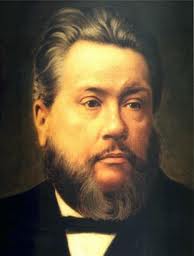 Calvinist Baptist
Spurgeon was born in Kelvedon, Essex, to a family of clerics. His father and grandfather were Nonconformist ministers (meaning they weren't Anglicans), and Spurgeon's earliest memories were of looking at the pictures in Pilgrim's Progress and Foxe's Book of Martyrs. His formal education was limited, even by nineteenth-century standards: he attended local schools for a few years but never earned a university degree. He lived in Cambridge for a time, where he combined the roles of scholar and teaching assistant and was briefly tutored in Greek. Though he eschewed formal education, all his life he valued learning and books—especially those by Puritan divines—and his personal library eventually exceeded 12,000 volumes. At age 15, Spurgeon broke with family tradition by becoming a Baptist. He attributed this conversion to a sermon heard by "chance"—when a snowstorm blew him away from his destination into a Primitive Methodist chapel. The experience forced Spurgeon to re-evaluate his idea on, among other things, infant baptism. Within four months he was baptized and joined a Baptist church. His theology, however, remained more or less Calvinist, though he liked to think of himself as a "mere Christian." "I am never ashamed to avow myself a Calvinist," he once said. "I do not hesitate to take the name of Baptist, but if I am asked what is my creed, I reply, 'It is Jesus Christ.'" Preaching sensation Still a teen, Spurgeon began preaching in rural Cambridgeshire. He quickly filled the pews in his first pastorate in the village of Waterbeach. He had a boyish appearance that contrasted sharply with the maturity of his sermons. He had a good memory and always spoke extemporaneously from an outline. His energy and oratorical skills and harmonious voice earned him such a reputation that within a year and a half, he was invited to preach in London, at the historic New Park Street Chapel. The congregation of 232 was so impressed, it voted for him to preach an additional six months. He moved to the city and never left. As word spread of his abilities, he was invited to preach throughout London and the nation. No chapel seemed large enough to hold those who wanted to hear the "the preaching sensation of London." He preached to tens of thousands in London's greatest halls—Exeter, Surry Gardens, Agricultural. In 1861 his congregation, which kept extending his call, moved to the new Metropolitan Tabernacle, which seated 5,600. At the centre of controversy Spurgeon did not go unnoticed in the secular press. On the one hand, his sermons were published in the Monday edition of the London Times, and even the New York Times. On the other hand, he was severely criticized by more traditional Protestants. His dramatic flair—he would pace the platform, acting out biblical stories, and fill his sermons with sentimental tales of dying children, grieving parents, and repentant harlots—offended many, and he was called "the Exeter Hall demagogue" and "the pulpit buffoon." Spurgeon replied, "I am perhaps vulgar, but it is not intentional, save that I must and will make people listen. My firm conviction is that we have had enough polite preachers." Not only his style, but his convictions created controversy as well. He never flinched from strong preaching: in a sermon on Acts 26:28, he said, "Almost persuaded to be a Christian is like the man who was almost pardoned, but he was hanged; like the man who was almost rescued, but he was burned in the house. A man that is almost saved is damned." On certain subjects, he was incapable of moderation: Rome, ritualism, hypocrisy, and modernism—the last of which became the centre of a controversy that would mark his last years in ministry. The "Down-Grade Controversy," as it came to be known, was started in 1887 when Spurgeon began publicly claiming that some of his fellow Baptist ministers were "down grading" the faith. This was the late-nineteenth century, when Darwinism and critical biblical scholarship were compelling many Christians to re-evaluate their understanding of the Bible. Spurgeon believed the issue was not one of interpretation but of the essentials of the faith. He proclaimed in his monthly, The Sword and the Trowel, "Our warfare is with men who are giving up the atoning sacrifice, denying the inspiration of Holy Scripture, and casting slurs upon justification by faith." The controversy took its toll on the denomination (which censured Spurgeon) and upon Spurgeon, whose already delicate health deteriorated even more during the year-long affair (he suffered from, among other things, recurring depressions and gout). Spurgeon's contributions were larger than his pulpit, however. He established alms houses and an orphanage, and his Pastor's College, opened in 1855, continues to this day. He preached his last sermon in June 1891 and died six months later. When Charles Spurgeon died in January 1892, London went into mourning. Nearly 60,000 people came to pay homage during the three days his body lay in state at the Metropolitan Tabernacle. Some 100,000 lined the streets as a funeral parade two miles long followed his hearse from the Tabernacle to the cemetery. Flags flew at half-staff and shops and pubs were closed. |
| View book information View devotional |
| For more than 150 years, Morning and Evening has provided millions of readers encouragement, challenge, and thought-provoking insight from the pen of one of history's most beloved preachers, Charles H. Spurgeon. Spurgeon's sermons and other writing have touched countless lives, and his insight into perseverance through times of trial while relying on God's immeasurable strength still speaks to readers today. This fantastic gift edition of Spurgeon's bestselling daily devotional contains the complete, original twice-daily text |
| View author information View devotional |

|

|